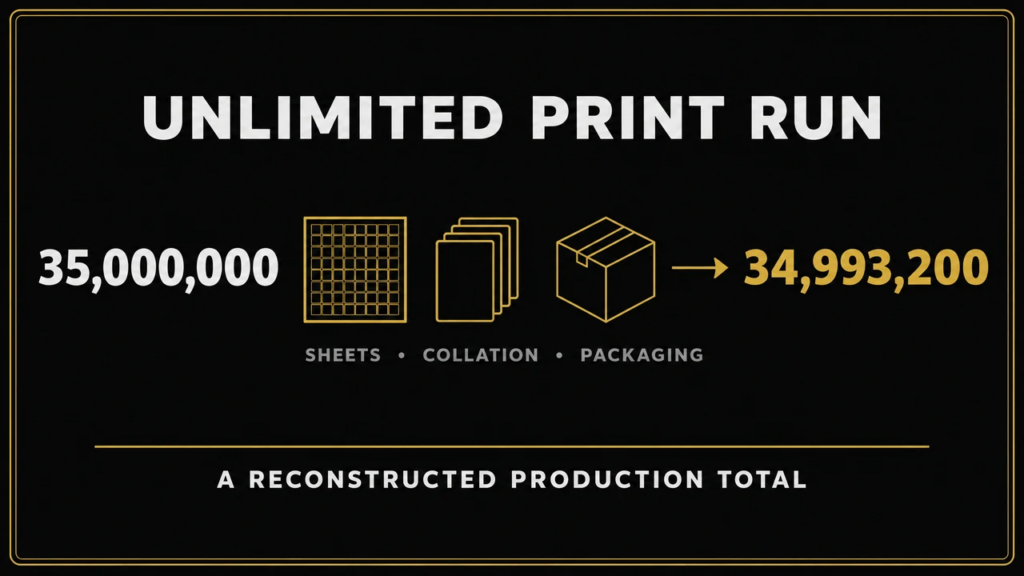
Historians and collectors usually describe the MTG Unlimited print run as 35 million cards. That figure remains useful, historically well established and accurate at its published level of precision. It is not, however, a factory ledger precise to the final card.
MTGPrintRun’s adopted industrial model closes at 34,993,200 cards. The difference is only 6,800 cards, or 0.0194% of the rounded 35-million figure. The two numbers do not describe competing histories. One is a rounded public total; the project’s approved sheet, collation and packaging constraints yield the other as the unique production total.[1] [2]
Quick answer: Collectors and historical sources commonly describe Unlimited as a 35-million-card printing. Under the validated MTGPrintRun model, the physical production system closes at 34,993,200 cards. This reconstruction follows stated constraints; it does not come from a surviving Wizards of the Coast factory ledger.
What was Unlimited Edition?
Wizards of the Coast released Unlimited Edition on December 1, 1993. It contained 302 cards, the same card list as Limited Edition Beta, but changed the border from black to white. Unlimited was also the final core-set printing to include the Power Nine.[3] [4]
The edition arrived after Alpha and Beta had sold through rapidly. Its much larger production run made early Magic cards more widely available while preserving the visual distinction between the black-bordered Limited Edition printings and the new white-bordered release.[4]
| Edition fact | Unlimited |
|---|---|
| Release date | December 1, 1993 |
| Set size | 302 cards |
| Border | White |
| Expansion symbol | None |
| Public print-run figure | Approximately 35 million cards |
| MTGPrintRun reconstructed total | 34,993,200 cards |
The 302-card checklist includes 117 rares, 95 uncommons, 75 commons and fifteen basic-land entries representing three artworks for each land type.[1] This composition matches Beta, but the production scale is far larger.
Why 35 million is not an exact factory total
A rounded historical number can be correct without being exact to the unit. “35 million” communicates the scale of Unlimited clearly. It does not specify how many complete press sheets the factory printed, how the packaging line consumed the rarity streams, or how it divided the cards between sealed products.
That distinction matters because a card factory cannot package an abstract total. It must print whole sheets, cut whole cards and assemble complete products. Early Magic used 121-position sheets in an 11×11 grid. The rare, uncommon and common streams therefore had to originate from whole sheet impressions.[2] [5]
A literal total of 35,000,000 fails even the first geometric test: it leaves a remainder of 24 cards when divided by 121. The reconstructed total of 34,993,200 divides cleanly into 289,200 complete 121-card sheets across the production system.
This test alone does not prove the final answer. Many totals can be divisible by 121. It does show why readers should not treat a nearest-million commercial figure as a final press-room count.
The three constraint layers behind the reconstruction of the Unlimited print run
The Unlimited result comes from reconciling three different parts of the manufacturing system. A candidate must satisfy all three simultaneously.
1. Printing-sheet geometry
The factory had to produce every rarity stream from complete 121-card sheets. A valid model cannot require a fraction of a sheet or leave a few impossible card positions outside the production plan.
The relevant principle is simple:
Cards produced from a sheet stream = sheet impressions × 121
The actual allocation is more complex because basic lands occupied positions across the early rarity sheets. This “land invasion” affects the balance between spell cards and lands, so a valid model must follow the documented sheet structures rather than divide the total evenly by the checklist size.[2]
2. Sealed-product collation
Wizards sold Unlimited in 15-card booster packs and 60-card randomized starter decks. The booster composition followed the established early-Magic structure: one rare-stream card, three uncommon-stream cards and eleven common-stream cards. A starter used two rare-stream cards, thirteen uncommon-stream cards and forty-five common-stream cards.[1] [2]
| Product | Rare stream | Uncommon stream | Common stream | Total cards |
|---|---|---|---|---|
| Booster pack | 1 | 3 | 11 | 15 |
| Starter deck | 2 | 13 | 45 | 60 |
This creates conservation equations. Printed sheets had to supply every card that the packaging line used, and the model must assign every counted card to a product. A candidate total that works only at edition level but fails one rarity stream is invalid.
3. Packaging and distribution integrity
Wizards did not ship the cards as loose mathematical units. The packaging line placed booster packs in boxes, starter decks in displays and the retail units in master cases. The adopted Unlimited model requires whole packaging units at every relevant level.[1]
This is an important difference between fitting an estimate and reconstructing a production plan. An estimate can stop when the total looks close to 35 million. A production reconstruction must close without fractional sheets, fractional packs, fractional displays or fractional cases.
Why the model closes at 34,993,200
The adopted model applies the sheet, collation and packaging constraints together and identifies 34,993,200 as the compatible total near the historical 35-million figure.[1]
| Comparison | Cards | Difference from public figure |
|---|---|---|
| Rounded public figure | 35,000,000 | — |
| Reconstructed production total | 34,993,200 | −6,800 |
| Relative difference | — | −0.0194% |
The small size of the difference is significant. It shows that the public figure was not “wrong” in any practical historical sense. The public figure simply rounds the total to a sensible level for readers. The reconstruction adds industrial precision without pretending that an archival source published 34,993,200 as a final factory count.
This is why MTGPrintRun classifies the result as a Reconstructed Print Run. It is exact under the adopted constraints, but MTGPrintRun does not label it “Confirmed” because no identified factory ledger directly records the final number.[1]
What the total does—and does not—tell us
A precise edition total establishes the scale of production. It also provides the denominator needed for card-level models. It does not mean that the factory printed every card in the same quantity.
Rarity came from sheet position and frequency. A card appearing once on a rare sheet did not receive the same number of copies as a common occupying several positions on a more frequently printed sheet. Basic lands need still more care because the factory distributed them across multiple sheet classes.[2] [5]
Researchers must also separate the production total from today’s surviving population. More than three decades of loss, damage, destruction, alteration and play have reduced that population. Grading-company population reports count only submitted cards and can include crossovers or resubmissions. They cannot convert a 1993 print run into a complete modern census.[2]
The defensible distinction is:
| Measure | Meaning |
|---|---|
| Print run | Original production represented by the reconstructed edition output |
| Surviving population | Cards still physically existing today |
| Graded population | Cards that one or more grading services record |
The 34,993,200-card model addresses only the first measure.
Why Unlimited is a useful test of print-run research
Alpha and Beta benefit from later disclosures tied to original Carta Mundi production records. Unlimited presents a harder problem: the historical record rounds the total, and no comparable final ledger supplies the full product split.[2] [6]
That makes Unlimited an important methodological bridge. It tests whether an industrial model can move from confirmed early-production structures to a later printing whose scale is known but whose final plan is incomplete in the public record.
The correct approach is not to choose an appealing per-card figure and work backwards. It is to require all independent constraints to agree: sheet geometry, product collation and whole-unit logistics. If one layer fails, the candidate is rejected even when its total looks plausible.
Why this matters to collectors
Collectors often compare Unlimited cards with their Beta and Revised counterparts. A collector may see the same name and artwork across several editions, but the edition determines the production population behind that copy.
A reliable print-run baseline helps answer three separate questions:
- Which printing is this card from?
- How was that printing manufactured and collated?
- How much original supply did that production plan create?
Many additional factors influence price, including condition, demand, tournament use, collector preference and the number of copies still available. Print-run data does not replace market analysis. It supplies the historical production baseline that market analysis often lacks.
For card-by-card figures and the current Free/Premium data boundary, use the Unlimited Edition database. For the general framework, read how MTG print runs are calculated and the guide to 121-position MTG print sheets.
Unlimited print run Frequently asked questions
How large was the Unlimited MTG print run?
Public sources commonly report approximately 35 million cards. MTGPrintRun’s adopted reconstruction closes at 34,993,200 cards under the project’s validated sheet, collation and packaging constraints.[1]
Is 34,993,200 an official Wizards factory number?
No. It is a reconstructed print run, not a directly confirmed factory ledger. The result is exact under the stated model constraints and remains compatible with the rounded historical figure of 35 million.[1]
Why can’t the print run be exactly 35,000,000 cards?
Factories printed early Magic cards on complete 121-position sheets, and packaging lines then collated them into complete sealed products. A literal 35,000,000-card total does not divide into whole 121-card sheets; it leaves a remainder of 24 cards. Sheet divisibility is only one test, but it immediately shows that the public figure uses rounding.[2] [5]
Did Unlimited use the same card list as Beta?
Yes. Both editions contain 302 cards. Unlimited changed the border from black to white and expanded production substantially.[3] [4]
Does the print run equal the number of surviving Unlimited cards?
No. The print run measures original production. The surviving population is lower, and no current method can count it exactly because of loss, damage, destruction and incomplete grading data.[2]