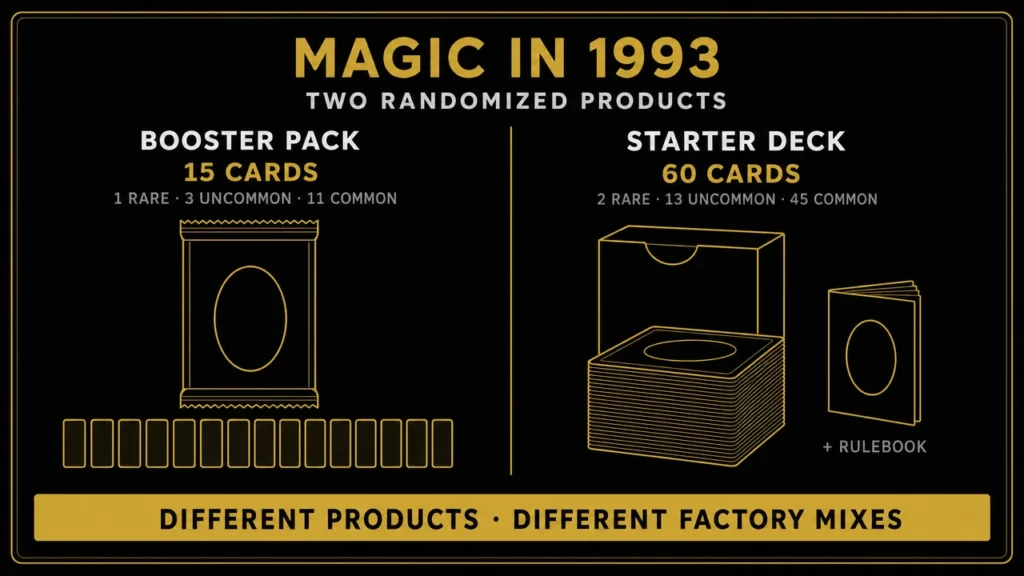
Wizards of the Coast launched the game with two simple products: booster packs and starter deck. Both contained randomized cards. Each served a different purpose.
Magic: The Gathering entered stores in 1993 without theme decks, collector boosters, bundles, or Commander products.
Booster packs expanded a collection. Starter decks supplied more cards, more lands, and the original rulebook.
Quick answer: An Alpha booster contained 15 cards. An Alpha starter contained 60 random cards plus a rulebook. Neither product contained a fixed deck list.
What did an Alpha booster pack contain?
A Limited Edition Alpha booster contained fifteen cards.[1]
| Rarity stream | Cards per booster |
|---|---|
| Rare | 1 |
| Uncommon | 3 |
| Common | 11 |
| Total | 15 |
The pack did not include a modern dedicated land slot. Basic lands appeared across the rare, uncommon and common print sheets.[2]
As a result, a land could enter the pack through any rarity stream. A buyer could open a basic land where a rare spell might otherwise appear.
The sealed wrapper hid both the card identities and their sequence. Carta Mundi’s collation machinery assembled cards from the three production streams.[3]
What did an Alpha starter deck contain?
An Alpha starter deck contained sixty random cards.[1]
| Rarity stream | Cards per starter |
|---|---|
| Rare | 2 |
| Uncommon | 13 |
| Common | 45 |
| Total | 60 |
The box also included the original Magic rulebook. Observed collation places that booklet between the uncommon and common groups.[1]
Despite its name, the product was not a modern preconstructed deck. It did not promise a specific colour pair, strategy, mana curve, or playable final list.
Mark Rosewater later described the old starter as “a random 60-card deck that came with two rares.”[2]
Players still needed to examine the cards, trade with others, and build a functioning deck.
Why did Wizards call it a starter deck?
The product gave a new customer a larger starting pool than a booster. It also supplied the rules needed to learn the game.
The original rulebook opens its first-game section by imagining that the reader has two decks available. It then explains shuffling, drawing seven cards, playing lands, casting spells, and attacking.[4]
Early deck construction also required fewer cards than today. Limited Edition used a forty-card minimum without the later four-copy limit.[2]
A sixty-card random starter therefore provided enough material for experimentation. It did not guarantee a polished deck.
This design supported Magic’s original social model. Players opened different cards, discovered unknown strategies, traded, and gradually improved their collections.
Booster packs and starter decks served different players
The two products created different buying experiences.
| Product | Primary role in 1993 | Main limitation |
|---|---|---|
| Booster pack | Add new cards to an existing pool | Too few cards to begin alone |
| Starter deck | Provide a larger first collection and rules | Random contents could lack balance |
A booster offered a compact surprise. A starter offered a broader sample of the game.
Neither product solved deck construction automatically. That uncertainty formed part of Magic’s original appeal.
Players could encounter cards their friends had never seen. Trading mattered because every local collection developed differently.
How did the two products affect factory production?
Booster packs and starter decks consumed rarity streams at different rates.
One booster required one rare, three uncommons and eleven commons. One starter required two rares, thirteen uncommons and forty-five commons.
Carta Mundi therefore could not divide the total print run by card count and obtain every production quantity. The factory also had to satisfy the product mix.
For any early edition, researchers need to know:
- How many boosters entered production.
- How many starter decks entered production.
- How many cards of each rarity each product consumed.
- How the factory arranged cards on 121-position sheets.
Those inputs connect retail packaging to card-level scarcity. The companion guide explains how 121-position MTG print sheets created rarity.
How many Alpha boosters and starters existed?
Original Carta Mundi records later confirmed approximately 70,000 Alpha boosters and 26,000 starter decks.[5]
A zero-remainder reconstruction based on sealed-product composition and 121-position sheets gives the exact counts used by MTG Print Run:[6]
| Alpha sealed product | Reconstructed quantity |
|---|---|
| Booster packs | 69,768 |
| Starter decks | 26,100 |
These quantities account for exactly 2,609,728 Alpha cards. They also close across the rare, uncommon and common sheets without leftover cards.
See the complete Alpha production data and the documented MTG Print Run methodology.
How did Beta change the scale?
Beta kept the same two product types and card composition.[5] Wizards simply produced a much larger run after Alpha sold out.
The exact reconstruction gives:
| Beta sealed product | Reconstructed quantity |
|---|---|
| Booster packs | 209,304 |
| Starter decks | 78,300 |
Beta therefore expanded the supply while preserving the original packaging model.
Explore the complete Beta production data.
Why the starter deck disappeared
The original starter deck belonged to an era when the product also had to teach the game.
Later Magic releases introduced clearer beginner products and preconstructed decks. Those products removed much of the uncertainty from a first purchase.
The term “starter deck” eventually became misleading. Modern players often expect a ready-to-play list, while the 1993 product contained randomized cards.
That historical distinction matters when studying sealed Alpha and Beta products. A sealed starter is not merely an old deck box. It contains a randomized cross-section of the first Magic print run and the rulebook that introduced the game.
What the packaging reveals about early Magic
Magic’s first products combined three functions:
- They distributed randomized cards.
- They taught customers how to play.
- They created a reason to trade and buy more cards.
The booster pack made expansion easy. The starter deck made entry possible. Together, they supported both the game and its emerging secondary market.
They also left a mathematical record. Every rare, uncommon and common in those products originated from a known sheet stream.
That relationship lets researchers move backwards from sealed production to per-card quantities more than thirty years later.
Frequently asked questions
Was an Alpha starter deck preconstructed?
No. It contained sixty random cards and a rulebook. It did not provide a fixed deck list or strategy.
How many cards were in an Alpha booster pack?
An Alpha booster contained fifteen cards: one rare, three uncommons and eleven commons.
How many rares were in an Alpha starter deck?
Each starter contained two rares, thirteen uncommons and forty-five commons.
Did Alpha boosters contain a dedicated basic land slot?
No. Basic lands appeared on several print sheets and could enter different rarity streams.
Why do starter quantities matter for print-run calculations?
Starters used a different rarity mix from boosters. Researchers need both product quantities to reconstruct the sheet runs correctly.