Modern Magic players see rarity through expansion symbols. Early Magic cards had no such visual system.
Alpha and Beta cards show no expansion symbol. They also lack a printed rarity marker. Their scarcity came from the factory process behind them.
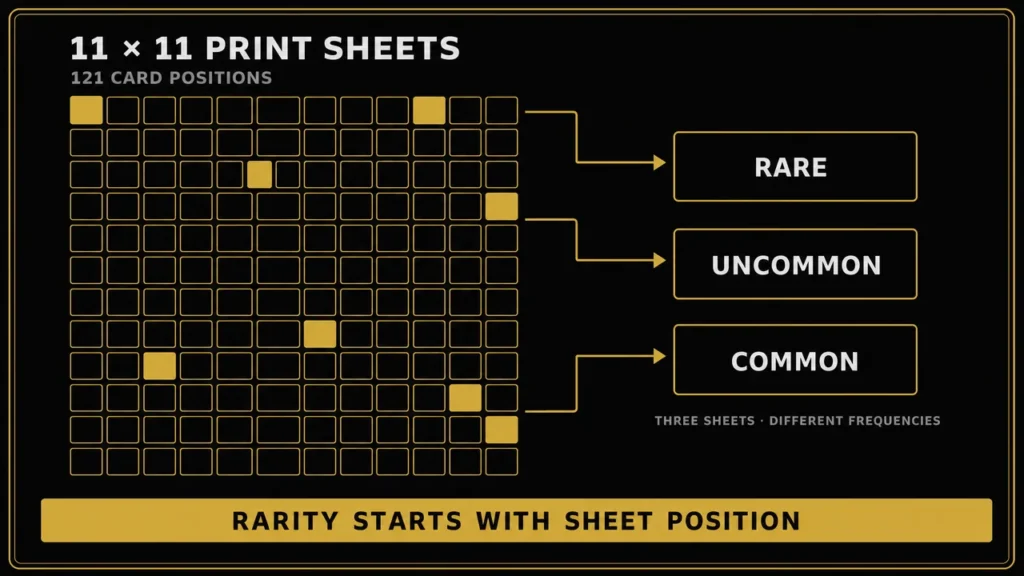
Carta Mundi printed the first Magic cards on 11×11 sheets. Each sheet held exactly 121 card positions.[1] The factory used separate sheets for rare, uncommon and common cards.
Quick answer: A card became rare because it occupied a position on a less frequently printed sheet. Its physical sheet placement created its scarcity.
What is an MTG print sheet?
A print sheet is a large sheet of card stock containing many card images. The printer produces the full sheet, applies finishing processes, and cuts it into individual cards.
For Limited Edition Alpha, each production sheet contained 121 positions. Carta Mundi arranged those positions in eleven rows and eleven columns.[1]
The first Magic release used three main sheet classes:
| Sheet | Main contents | Product slot supplied |
|---|---|---|
| Rare sheet | Rare cards and some basic lands | Rare slots |
| Uncommon sheet | Uncommon cards and some basic lands | Uncommon slots |
| Common sheet | Common cards and basic lands | Common slots |
The factory did not print each card separately. It printed complete sheets, cut them, and collated the cards into sealed products.
That detail turns rarity into an industrial question.
Why did early Magic print sheets use 121 positions?
Carta Mundi’s production system used an eleven-by-eleven card layout for Limited Edition.[1] The fixed sheet size forced every card category into 121 available positions.
Alpha contained 116 named rares. The rare sheet therefore had more positions than unique rare spells.[1] Other cards had to occupy the remaining space.
The same constraint affected uncommon and common sheets. Alpha contained 95 uncommons and 74 commons, while every sheet still required 121 filled positions.[1]
Basic lands helped complete those layouts. They appeared across the sheet classes instead of using a dedicated land sheet.[2]
This explains one of early Magic’s strangest outcomes: a booster could supply a basic land from its rare or uncommon slot.
How did print sheets placement determine rarity?
Consider a card that appears once on a 121-position print sheets.
Each time the factory prints that sheet, it produces one copy of that card. If the factory prints the sheet 1,000 times, the card receives 1,000 copies.
Now consider a card that appears three times on the same sheet. Every sheet impression produces three copies. After 1,000 impressions, that card receives 3,000 copies.
The general relationship is simple:
Copies produced = sheet impressions × positions occupied by the card
This framework explains labels such as U1, U2 or C4 in early expansion research. The letter identifies the sheet class. The number identifies how many positions the card occupied.
A U2 card appears twice on the uncommon sheet. A C4 card appears four times on the common sheet. The printed quantity therefore depends on both the sheet run and the position count.
How did print sheets feed booster packs?
Alpha booster packs contained fifteen cards:
| Slot class | Cards per booster |
|---|---|
| Rare | 1 |
| Uncommon | 3 |
| Common | 11 |
| Total | 15 |
The packaging system drew each group from its corresponding production stream.[1] Carta Mundi used specialized collation equipment to assemble the randomized packs.[3]
This process linked the factory sheets directly to the consumer experience. The rare sheet supplied one slot. The uncommon sheet supplied three. The common sheet supplied eleven.
A printed rarity label was unnecessary. The packaging ratio already enforced rarity.
How did starter decks change the production mix?
Original starter decks contained sixty random cards, not a fixed deck list. They included two rares, thirteen uncommons and forty-five commons.[1]
| Slot class | Cards per starter deck |
|---|---|
| Rare | 2 |
| Uncommon | 13 |
| Common | 45 |
| Total | 60 |
Starter decks also included the rulebook.[1] The original rules expected new players to begin with these products and build decks from randomized cards.[4]
Because booster packs and starter decks used different rarity ratios, the factory needed a production mix that could supply both products. Any exact print-run model must therefore account for both formats. Read how Magic was sold through boosters and starter decks in 1993 for the product-level context.
This is why total card volume alone cannot reveal every per-card quantity. Researchers also need the product split and the sheet structure.
What did the 121-position sheets produce in Alpha?
The confirmed factory totals, combined with a zero-remainder model, allow MTG Print Run to reconstruct Alpha’s sheet runs. The resulting per-card quantities are:[6]
| Alpha rarity | Copies per standard card |
|---|---|
| Rare | 1,008 |
| Uncommon | 4,530 |
| Common | 16,030 |
These values describe standard non-land cards occupying one relevant sheet position. Basic lands require separate treatment because they appeared across multiple sheet classes.
The key point is not the arithmetic itself. The result depends on connecting factory totals, sealed-product composition and physical sheet size.
Explore the full Alpha print run data or read the project’s calculation methodology.
Why can a basic land replace a rare card?
Early Magic did not use a dedicated basic land sheet. Carta Mundi placed lands into open positions across the rare, uncommon and common sheets.[2]
When the collation system selected a card from the rare stream, it followed the sheet sequence. If a basic land occupied that position, the pack received that land.
The product still contained a card from the rare sheet. It simply did not contain a rare spell.
Later products separated lands more cleanly. Limited Edition preserves the original manufacturing compromise.
Why exact print sheets layouts matter
A total print run tells us how many cards existed across an edition. It does not automatically reveal how many copies existed for each card.
Researchers need several linked inputs:
- Total sealed-product quantities.
- The card composition of each product.
- The 121-position sheet size.
- The number of positions assigned to each card.
- The collation rules used during packaging.
Missing one input can produce a plausible but incorrect answer.
This distinction matters most for editions with repeated cards on the same sheet. It also matters for basic lands, art variants and products with unusual collation.
What print sheets reveal about Magic history
The first Magic set combined game design with manufacturing constraints. Rarity did not exist independently from the press room.
A designer could call a card rare. Carta Mundi still needed to assign it a physical position, print the sheet, cut it, and place it into products.
The 11×11 format therefore shaped collecting history. It determined the available slots, forced lands onto several sheets, and created measurable relationships between cards.
Today, those same relationships let researchers reconstruct early production with unusual precision.
Frequently asked questions
How many cards were on an early MTG print sheet?
Limited Edition Alpha and Beta used 11×11 sheets containing 121 card positions.
Did Alpha cards show their rarity?
No. Alpha cards had no expansion symbol or printed rarity marker. Their sheet placement and collation determined rarity.
Could a basic land occupy the rare slot?
Yes. Basic lands appeared on rare, uncommon and common sheets in Limited Edition. A land could therefore come from the rare stream.
What does U2 mean on an early Magic card list?
U2 means the card occupied two positions on the uncommon sheet. Each sheet impression produced two copies.
Why is total print run insufficient for per-card estimates?
Researchers also need product composition, sheet size, card frequency and collation. Total volume alone cannot determine every card quantity.