The Unlimited vs Revised MTG comparison confuses collectors for a simple reason: both editions can show a white border, the original card frame, no expansion symbol and no printed copyright year. From a distance, many cards look almost identical.
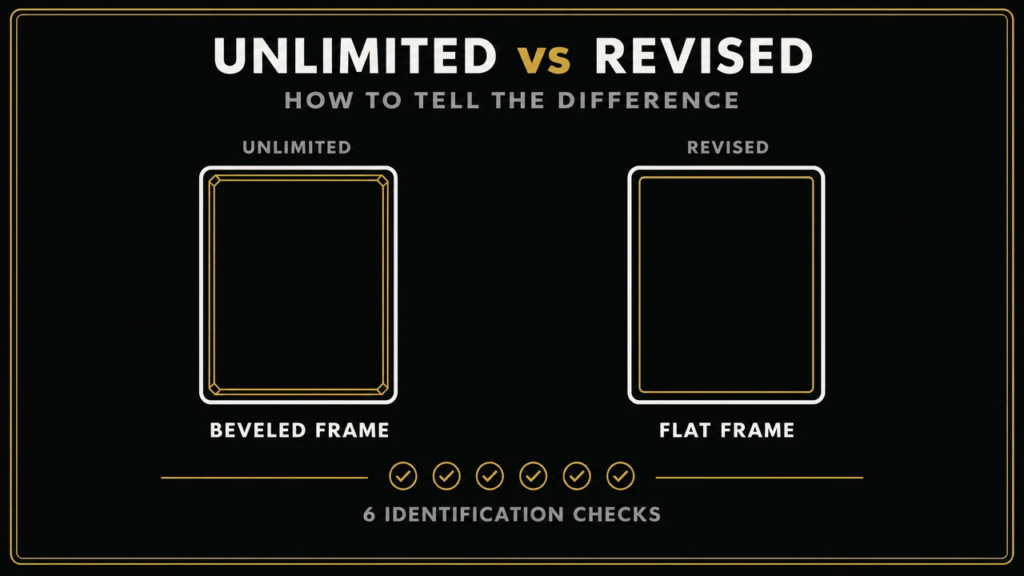
The best identification method is the inner border. Unlimited cards retain a beveled frame immediately inside the thin black border line. Revised cards use a flatter, single-line transition. Other clues—including the original tap symbol, artifact type line, text placement and color saturation—can confirm the result.[1] [2]
Quick answer: Look first at the narrow frame between the white outer border and the colored card area. A beveled, dimensional inner frame indicates Unlimited. A flat inner frame indicates Revised. Use at least one additional cue before authenticating an expensive card.
Unlimited vs Revised at a glance
Wizards of the Coast released Unlimited Edition on December 1, 1993. It contained 302 cards and reproduced the Beta checklist with white borders. Revised Edition followed on April 11, 1994 with 306 cards and a changed card pool.[3] [4] [5]
| Feature | Unlimited | Revised |
|---|---|---|
| Release date | December 1, 1993 | April 11, 1994 |
| Set size | 302 cards | 306 cards |
| Outer border | White | White |
| Expansion symbol | None | None |
| Printed year | None | None |
| Primary visual cue | Beveled inner frame | Flat inner frame |
| Power Nine | Present | Not present |
These similarities make identification harder than Alpha versus Beta. Alpha’s corners are visibly different, while Unlimited and Revised share the standard card shape. The correct test therefore focuses on the printing frame and typography rather than on the outer silhouette.
1. Check the beveled inner border first
The inner-frame test is the most useful signal because it applies across the set and does not depend on the card having a particular ability.
Start at the white outer border and move inward. You will cross a thin black line before reaching the colored card frame.
- On an Unlimited card, a narrow light-and-dark bevel sits inside that line. The transition looks dimensional, like the black-bordered Alpha and Beta frame translated to a white-bordered card.
- On a Revised card, the transition is flat. The colored frame meets a simpler black outline without the same beveled depth.[1] [2]
This difference can be subtle in photographs. Inspect the left or right side under neutral light, and compare the card with a known example when possible. Image compression, glare and sleeve texture can hide the bevel.
| Inner-frame appearance | Likely edition |
|---|---|
| Thin black line followed by a visible light/dark bevel | Unlimited |
| Flat black outline with no dimensional bevel | Revised |
For valuable cards, do not rely on a marketplace thumbnail. Request a high-resolution, unsleeved image showing the vertical frame and the card back.
2. Look for the original tilted-T tap symbol
Revised introduced Magic’s first dedicated tap symbol: a grey circle containing a tilted T. Unlimited cards do not use that symbol; earlier cards usually write the action in words or reflect the old artifact-type system.[1] [2]
This creates a conclusive one-way test:
If an otherwise early, white-bordered, symbol-free card shows the tilted-T tap symbol, it is Revised—not Unlimited.
The limitation is coverage. Many cards have no activated ability requiring a tap symbol, so its absence does not prove that a card is Unlimited. Use the symbol when present; otherwise return to the border test.
3. Read the artifact type line
The early rules divided artifacts into categories such as Mono Artifact, Poly Artifact and Continuous Artifact. Unlimited preserved those type lines. Revised simplified the printed type to Artifact and used the tap symbol where necessary.[1] [2]
| Printed type line | Identification value |
|---|---|
| Mono Artifact, Poly Artifact or Continuous Artifact | Strong Unlimited cue |
| Artifact, combined with the tilted-T symbol where applicable | Strong Revised cue |
This clue is especially practical because it uses legible printed text rather than a fine border detail. It applies only to artifact cards, but on those cards it can resolve uncertainty quickly.
Rules databases may display modern Oracle types instead of the historical printed line. Identification must use the physical wording printed on the card, not current rules text.
4. Compare card-name and artist-credit placement
Unlimited and Revised used slightly different positioning inside the frame. On many Unlimited cards, the card name sits closer to the inner border. Revised generally leaves more space before the title text. At the bottom, Unlimited artist credits sit slightly higher, while Revised credits often appear closer to the lower line.[2] [6]
These cues are helpful in a side-by-side comparison but weaker in isolation. Centering can vary by card, scan angle and print registration. Treat typography placement as confirmation after the border test, not as the first and only verdict.
A practical inspection order is:
- Examine the inner-frame bevel.
- Check for a tilted-T tap symbol.
- Read the artifact type line, if relevant.
- Compare title and artist-credit spacing with a known reference.
5. Use color saturation as supporting evidence
Unlimited cards usually appear darker and more saturated. Revised is known for a paler, washed-out appearance, particularly when the same artwork is placed beside an Unlimited copy.[1] [2]
Color is not a safe standalone test. Unlimited itself shows printing variation, while photography introduces white-balance, exposure and display differences. A warm phone image can make Revised look richer; a bright scanner can make Unlimited look faded.
Use color only after structural cues. If the card has a visible bevel and richer color, the signals agree with Unlimited. If it has a flat frame and paler color, they agree with Revised. When the border and color appear to conflict, trust neither photograph blindly—inspect the physical card or obtain better images.
6. Check whether the card exists in both editions
The card name can sometimes settle the question before any close inspection. Unlimited reproduces Beta’s 302-card list and includes the Power Nine. Revised changed the card pool and removed the Power Nine.[3] [4]
A white-bordered, symbol-free Black Lotus, Mox, Ancestral Recall, Time Walk or Timetwister cannot be Revised. If authentic, its normal tournament-card printing is Unlimited. Collectors should still distinguish such cards from counterfeits and from non-tournament collector products with different physical characteristics.
The reverse logic also applies to cards introduced into the core set with Revised. If a card does not exist in Unlimited, the checklist can be conclusive. For cards shared by both sets—including the original dual lands—the visual frame remains necessary.
Use the Unlimited Edition checklist and Revised Edition checklist to verify whether a specific card appears in one or both printings.
A reliable six-point identification checklist
| Check | Unlimited | Revised | Strength |
|---|---|---|---|
| Inner border | Beveled, dimensional transition | Flat transition | Primary |
| Tap symbol | No tilted-T symbol | Tilted-T symbol on applicable cards | Conclusive when present |
| Artifact type | Mono, Poly or Continuous Artifact | Artifact | Strong on artifacts |
| Text placement | Title closer to frame; artist credit generally higher | More title spacing; artist credit generally lower | Supporting |
| Color | Usually darker and more saturated | Often paler and washed out | Supporting only |
| Card pool | Includes Power Nine and full Beta checklist | Power Nine removed; changed 306-card pool | Conclusive for edition-exclusive cards |
This checklist is designed for edition identification, not complete authentication. Counterfeit detection requires additional tests involving print pattern, registration, card stock, weight, fluorescence and comparison with known genuine cards.
Why the distinction matters
Unlimited and Revised are not merely two cosmetic versions of the same product. They represent different production moments.
MTGPrintRun reconstructs Unlimited at 34,993,200 cards, consistent with the rounded public figure of 35 million. The adopted Revised model closes at 526,858,200 cards under its declared constraints—just over fifteen times the Unlimited total.[3] [5]
Both are reconstructed production totals, not surviving-population counts and not factory-confirmed ledgers. They nevertheless establish a major difference in original supply. A shared card name and artwork can therefore sit on very different production baselines depending on the edition.
Collectors should still avoid reducing value to print run alone. Condition, play demand, edition preference and remaining supply all matter. Correct identification comes first because every later comparison depends on knowing which object is being evaluated.
Unlimited vs Revised: common identification mistakes
Assuming every faded card is Revised
Age, storage, light exposure and photography can alter appearance. A faded Unlimited card remains Unlimited if the frame and printed features identify it as such.
Treating the absence of a tap symbol as proof of Unlimited
Many Revised cards never needed the symbol. Presence is conclusive; absence is not.
Using current rules text instead of the printed type line
Oracle databases update historical cards. The artifact clue depends on what the physical card actually says.
Relying on a single low-resolution photograph
The bevel may disappear under glare, sleeves or image compression. Expensive purchases require several clear views and independent authentication.
Confusing print run with current population
Production totals measure cards created in the original run. They do not tell us exactly how many copies survive today or how many remain in collectible condition.
Frequently asked questions
What is the easiest way to tell Unlimited from Revised MTG cards?
Check the inner frame. Unlimited has a visible beveled transition inside the thin black border line. Revised uses a flatter inner frame.[1] [2]
Do Unlimited and Revised both have white borders?
Yes. Both editions use white outer borders, no expansion symbol and no printed year, which is why they are frequently confused.
Does the tilted-T tap symbol appear in Unlimited?
No. The original tilted-T tap symbol was introduced in Revised. Its presence identifies a card as Revised rather than Unlimited.[1]
Is darker color enough to prove a card is Unlimited?
No. Unlimited is generally more saturated and Revised often looks washed out, but print variation, lighting and scanning make color an unreliable standalone test.
Is Black Lotus in Revised Edition?
No. Revised removed the Power Nine. An authentic white-bordered tournament printing of Black Lotus is Unlimited, subject to normal authentication checks.[3] [4]
Which set had the larger print run?
Revised was much larger. MTGPrintRun’s adopted reconstructions are 34,993,200 cards for Unlimited and 526,858,200 for Revised, each exact under its stated conditions rather than directly confirmed by a surviving factory ledger.[3] [5]