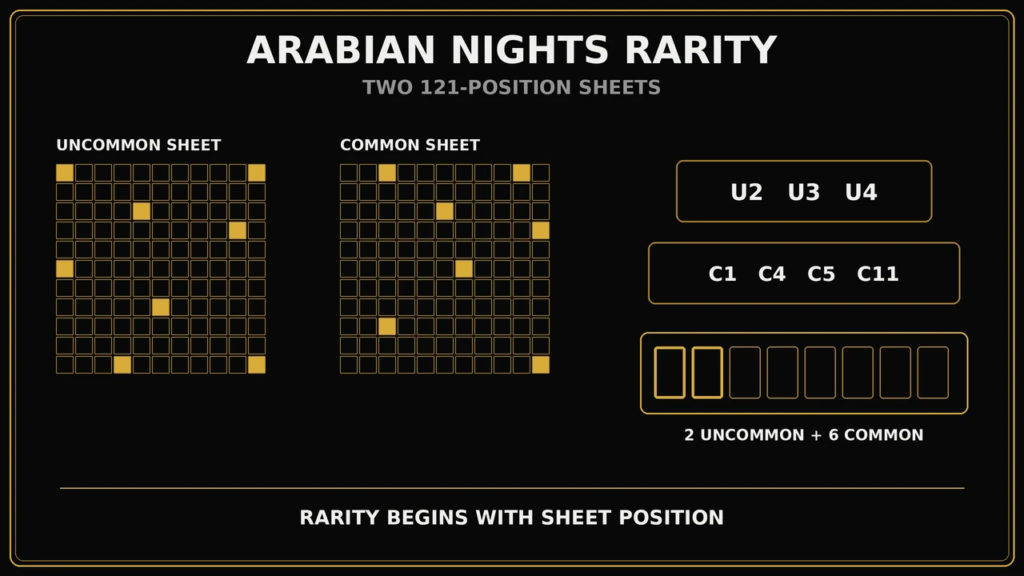
Arabian Nights rarity does not work like rarity in a modern Magic set. The 1993 expansion had no rare sheet, no colored rarity symbol and no collector number. Its 78 card names were printed on just two 121-position sheets: one uncommon sheet and one common sheet.[1] [2]
Codes such as U2, U3, C1 and C11 record physical sheet frequency. The letter identifies the sheet. The number tells you how many positions the card occupied on that sheet.
Quick answer: U2 means a card appeared twice on the 121-position uncommon sheet. C5 means it appeared five times on the common sheet. The code measures sheet placement—not a modern rarity label. Because the common sheet was printed three times as often as the uncommon sheet in the adopted model, a C1 card and a U3 card produced the same number of copies.
How Arabian Nights was printed
Wizards of the Coast released Arabian Nights on December 17, 1993 as Magic’s first expansion. It contained 78 card names and was sold only in eight-card booster packs.[2] [3]
Each booster drew cards from two production streams:
| Sheet stream | Cards per booster |
|---|---|
| Uncommon sheet | 2 |
| Common sheet | 6 |
| Total | 8 |
Both sheets used the same 11×11 format, giving each sheet 121 positions. The uncommon sheet held 51 different card names. The common sheet held 27, including Desert and the set’s only basic land, Mountain.[1] [2]
There was no third sheet dedicated to “rares.” The cards collectors normally call Arabian Nights rares are the least frequent cards on the uncommon sheet: the U2 group.
What the letter and number mean
The notation follows a compact rule:
Copies of a card = sheet impressions × positions occupied by that card
A U2 card appears twice on every uncommon sheet. A U3 card appears three times. A C4 card appears four times on each common sheet.
The full base-card frequency system is:
| Code | Sheet | Positions per sheet | Number of card names |
|---|---|---|---|
| U2 | Uncommon | 2 | 33 |
| U3 | Uncommon | 3 | 17 |
| U4 | Uncommon | 4 | 1 |
| C1 | Common | 1 | 1 |
| C4 | Common | 4 | 16 |
| C5 | Common | 5 | 9 |
| C11 | Common | 11 | 1 |
These allocations fill both sheets exactly:
- Uncommon sheet: 33 × 2 + 17 × 3 + 1 × 4 = 121 positions.
- Common sheet: 1 × 1 + 16 × 4 + 9 × 5 + 1 × 11 = 121 positions.[1]
The arithmetic is not an estimate. It is the physical layout required to fill each reconstructed 121-position sheet.
The complete Arabian Nights rarity hierarchy in the adopted model
The public historical total for Arabian Nights is generally stated as approximately five million cards. MTGPrintRun’s adopted reconstruction closes at 5,227,200 cards, exact under the documented sheet, booster and approved logistics constraints rather than confirmed by a final factory ledger.[4]
That model uses 10,800 uncommon-sheet impressions and 32,400 common-sheet impressions. Multiplying each frequency by its sheet run produces the following base-card quantities:[4]
| Code | Calculation | Copies per card | Relative scarcity |
|---|---|---|---|
| U2 | 10,800 × 2 | 21,600 | Rarest base-card group |
| U3 | 10,800 × 3 | 32,400 | Same copies as C1 |
| C1 | 32,400 × 1 | 32,400 | Same copies as U3 |
| U4 | 10,800 × 4 | 43,200 | More common than U3/C1 |
| C4 | 32,400 × 4 | 129,600 | Standard common-sheet group |
| C5 | 32,400 × 5 | 162,000 | More frequent common-sheet group |
| C11 | 32,400 × 11 | 356,400 | Most printed base-card frequency |
The key result is that the number after the letter cannot be read in isolation. A C1 card occupies fewer positions than a U2 card, but the common sheet ran three times as often. Sheet-run volume changes the final copy count.
Why C1 and U3 have identical rarity
Mountain is the only C1 base card in Arabian Nights. It appears once on the common sheet. A U3 card appears three times on the uncommon sheet.
At first glance, one position seems scarcer than three. The production runs reverse that intuition:
| Frequency | Sheet impressions | Positions | Copies |
|---|---|---|---|
| C1 | 32,400 | 1 | 32,400 |
| U3 | 10,800 | 3 | 32,400 |
The common sheet was printed exactly three times for every uncommon sheet in the adopted model, matching the booster’s six-to-two slot ratio. One position multiplied by 32,400 equals three positions multiplied by 10,800.
This is why Arabian Nights rarity must be evaluated through sheet frequency × sheet run, not by the code alone.
Which Arabian Nights cards are the “rares”?
The 33 U2 cards form the least printed base-card group at 21,600 copies each in the adopted reconstruction. Modern databases often label these cards as Rare for usability, even though the factory system used only uncommon and common sheets.[1] [2]
The U2 group includes many of the set’s best-known cards, such as Bazaar of Baghdad, Library of Alexandria, Juzám Djinn, Drop of Honey and Serendib Efreet. Their U2 status explains the production baseline. Their market prices, however, also reflect play demand, collector demand, condition and the surviving supply.
A frequency code is therefore a manufacturing fact, not a price forecast. Two U2 cards began with the same modeled print quantity but can have very different markets more than thirty years later.
What U3 and U4 mean
Seventeen cards appear as U3, producing 32,400 copies each. Oasis is the only U4, producing 43,200 copies.[1] [4]
The labels can mislead readers accustomed to modern rarity symbols. U4 does not mean “rarer than U3.” It means four positions instead of three, so it produced more copies per sheet impression.
Within the same sheet stream:
A higher frequency number means more copies, not greater rarity.
This rule holds because every impression of the uncommon sheet produces four copies of a U4 card but only two copies of a U2 card.
What C4, C5 and C11 mean
Most common-sheet cards appear four or five times. Sixteen base card names are C4, while nine are C5. Desert is the unique C11 card.[1]
| Common code | Base-card copies | Comparison |
|---|---|---|
| C4 | 129,600 | Four times the C1 quantity |
| C5 | 162,000 | Five times the C1 quantity |
| C11 | 356,400 | Eleven times the C1 quantity |
Desert’s eleven positions make it the most frequently produced base card in the set. Mountain sits at the opposite end of the common sheet with one position, but its 32,400-copy result still matches every U3 card because of the different sheet-run volumes.
How Light and Dark variants change the physical checklist
Fifteen common cards have both Light and Dark mana-symbol variants. These are not additional card names and do not change the 78-card base checklist. They are physical printing variants created because some positions appeared in a differently prepared quadrant of the common sheet.[1] [5]
A base frequency such as C4 or C5 can therefore be divided between two physical versions. Oubliette, for example, has a combined C4 frequency split between Light and Dark positions. The total base-card quantity still follows the C4 row, while each variant follows its documented position count.[1]
This is why collectors may discuss either:
- 78 base card names, which is the set size used by MTGPrintRun; or
- 93 physical checklist entries, when the fifteen additional Light/Dark versions are collected separately.
The companion guide to Arabian Nights Light and Dark variants explains the identification cues and the complete 15-card list.
Why modern rarity symbols are not enough
Modern Magic cards use a colored set symbol and collector information to communicate rarity and printing. Arabian Nights predates that system. Its scimitar symbol identifies the expansion, but it does not change color by rarity.[2]
A modern database must therefore translate the historical manufacturing system into a readable classification. MTGPrintRun presents 33 Rare, 18 Uncommon, 26 Common and one Basic Land at archive level while preserving the underlying U2/U3/U4 and C1/C4/C5/C11 codes in the production data.[4]
Both views answer different questions:
| View | Question answered |
|---|---|
| Modern archive label | How should the card be grouped for browsing? |
| Historical frequency code | How many positions did it occupy on the factory sheet? |
| Reconstructed copies | How many copies follow from frequency and sheet run? |
The historical code is the essential layer for print-run research.
How to read an Arabian Nights rarity code correctly
Use this three-step process:
- Identify the sheet. U means uncommon sheet; C means common sheet.
- Read the position frequency. The number is the count of positions occupied by that card.
- Apply the correct sheet run. Multiply by 10,800 for the uncommon sheet or 32,400 for the common sheet in the adopted reconstruction.
Do not compare U and C numbers directly without the third step. U3 and C1 demonstrate exactly why that shortcut fails.
For the complete archive and card-level production data, use the Arabian Nights Edition database. For the broader industrial framework, read how 121-position print sheets created early MTG rarity.
Frequently asked questions
Did Arabian Nights have rare cards?
It had no separate rare sheet. The 33 U2 cards were the least frequent base-card group and are generally treated as the set’s rares in modern classifications.[1] [2]
What does U2 mean in Arabian Nights?
U2 means that a card occupied two positions on the 121-position uncommon sheet. Under the adopted 10,800-sheet run, a U2 card produced 21,600 copies.[1] [4]
What does C1 mean?
C1 means one position on the common sheet. Mountain is the set’s C1 base card. Because the common sheet ran 32,400 times, Mountain’s modeled base quantity is 32,400 copies.[1] [4]
Are U3 and C1 equally rare?
Yes in the adopted production model. U3 gives 10,800 × 3 = 32,400 copies, while C1 gives 32,400 × 1 = 32,400 copies.[4]
What is the rarest Arabian Nights frequency?
U2 is the rarest base-card frequency at 21,600 copies per card in the adopted reconstruction.[4]
Why do some collectors say Arabian Nights has 93 cards?
The base set contains 78 card names. Fifteen common cards also have a second Light/Dark physical version. Counting those additional variants separately produces a 93-entry collector checklist.[1] [2]