Why Light and Dark Arabian Nights variants exist
Arabian Nights was printed on two 11×11 sheets: an uncommon sheet and a common sheet. Each contained 121 positions. The expansion was packaged in eight-card boosters with two cards from the uncommon stream and six from the common stream.[1] [3]
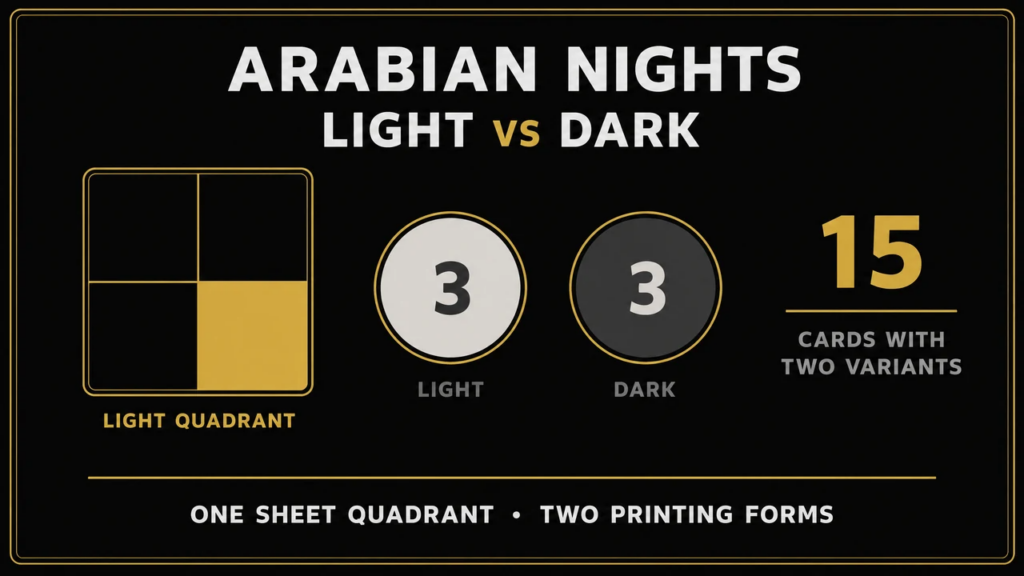
Evidence assembled by the Collation Project traces the variant difference to the lower-right six-by-six quadrant of the common sheet. That quadrant was prepared separately and retained a lighter mana-symbol treatment. Positions outside it used the darker treatment.[1]
When a card appeared both inside and outside the affected quadrant, the same card name entered production in two visible forms:
| Sheet position | Resulting variant |
|---|---|
| Position within the affected lower-right quadrant | Light mana-symbol version |
| Position outside the affected quadrant | Dark mana-symbol version |
This model explains three facts at once: only common-sheet cards are affected, the two versions have consistent sheet frequencies, and Light variants are often less frequent because fewer copies of a card occupied the affected quadrant.[1]
The explanation should not be simplified to “one early printing and one later printing.” The reconstructed sheet shows both variants as positions within the same common-sheet layout.
How to identify a Arabian Nights Light vs Dark variant
The safest approach is to inspect the mana symbols, not the overall frame or artwork.
Generic mana symbols
On cards with a generic mana cost, the difference is usually clearest inside the grey circle.
- Light variant: the circle appears paler, more white card stock remains visually present, and the numeral is generally larger.
- Dark variant: the grey looks denser and more heavily built from colored print dots; the numeral can appear smaller within the circle.[2] [4]
Rukh Egg is a frequently used reference because the generic symbol makes the contrast easy to see in a controlled side-by-side comparison.
Black mana symbols
Black cards such as Erg Raiders and Oubliette can also show a difference in the background of the black mana symbol. The Light and Dark versions use visibly different grey treatments when examined closely. A loupe helps separate the print-dot structure from ordinary aging, dirt or image compression.[2]
White mana symbols
Camel and other affected white cards may not provide a generic symbol in the most useful location. Their white mana symbols still show the quadrant-related printing difference. The area around the white symbol can reveal a distinct dot pattern and tone between variants.[2] [4]
What not to use as the only test
Do not classify a card solely because its whole face looks pale or dark. Storage, fading, scanner exposure, sleeve glare and print variation can change overall appearance. The diagnostic feature is the relevant symbol treatment, supported by the documented card list and sheet frequency.
The complete 15-card Arabian Nights Light vs Dark list
The adopted Arabian Nights reconstruction uses 32,400 common-sheet impressions. A C1 position therefore produces 32,400 copies, C2 produces 64,800, C3 produces 97,200 and C4 produces 129,600. The table below applies the documented Light/Dark position split to that public sheet run.[1] [3]
| Card | Dark frequency | Light frequency | Dark copies | Light copies | Combined copies |
|---|---|---|---|---|---|
| Army of Allah | C3 | C1 | 97,200 | 32,400 | 129,600 |
| Bird Maiden | C2 | C2 | 64,800 | 64,800 | 129,600 |
| Camel | C3 | C2 | 97,200 | 64,800 | 162,000 |
| Erg Raiders | C3 | C2 | 97,200 | 64,800 | 162,000 |
| Fishliver Oil | C3 | C1 | 97,200 | 32,400 | 129,600 |
| Giant Tortoise | C3 | C1 | 97,200 | 32,400 | 129,600 |
| Hasran Ogress | C3 | C2 | 97,200 | 64,800 | 162,000 |
| Moorish Cavalry | C3 | C2 | 97,200 | 64,800 | 162,000 |
| Nafs Asp | C3 | C2 | 97,200 | 64,800 | 162,000 |
| Oubliette | C2 | C2 | 64,800 | 64,800 | 129,600 |
| Piety | C3 | C1 | 97,200 | 32,400 | 129,600 |
| Rukh Egg | C3 | C1 | 97,200 | 32,400 | 129,600 |
| Stone-Throwing Devils | C3 | C1 | 97,200 | 32,400 | 129,600 |
| War Elephant | C3 | C1 | 97,200 | 32,400 | 129,600 |
| Wyluli Wolf | C4 | C1 | 129,600 | 32,400 | 162,000 |
These quantities are reconstructed results under the adopted 5,227,200-card Arabian Nights model. They are exact within that model and its documented sheet positions; they are not presented as a separately surviving factory ledger.[3]
Which Light variants are scarcer than their Dark counterparts?
The frequency table creates three patterns.
Dark-to-Light ratio of 3:1
Seven cards use a C3 Dark / C1 Light split: Army of Allah, Fishliver Oil, Giant Tortoise, Piety, Rukh Egg, Stone-Throwing Devils and War Elephant. Wyluli Wolf is even more uneven at C4 Dark / C1 Light.
For the C3/C1 group, the Light version has one third as many reconstructed copies as the Dark version. For Wyluli Wolf, the Light version has one quarter as many.
Dark-to-Light ratio of 3:2
Camel, Erg Raiders, Hasran Ogress, Moorish Cavalry and Nafs Asp use a C3 Dark / C2 Light split. Their Light versions remain less frequent, but the difference is smaller: two Light positions for every three Dark positions.
Equal-frequency variants
Bird Maiden and Oubliette use a C2/C2 split. Their Light and Dark versions have the same reconstructed production quantity under the adopted model.[1] [3]
| Pattern | Cards | Relative result |
|---|---|---|
| C4 Dark / C1 Light | 1 | Light has one quarter of Dark production |
| C3 Dark / C1 Light | 7 | Light has one third of Dark production |
| C3 Dark / C2 Light | 5 | Light has two thirds of Dark production |
| C2 Dark / C2 Light | 2 | Equal modeled production |
A label such as “Light” therefore does not imply one universal rarity premium. The exact relationship depends on the card’s position split.
Why only these fifteen cards have both variants
The affected positions belong to the common sheet, so no uncommon-sheet card has a Light/Dark pair in this system. The visible difference is most useful on cards containing generic, white or black mana symbols. Those symbol treatments preserve the detectable change between the separately prepared quadrant and the rest of the sheet.[1] [2]
Two common-sheet cards that might appear eligible—Cuombajj Witches and Desert Nomads—do not have positions in both relevant treatments and are not part of the fifteen-card Light/Dark list.[2]
The sheet model is more reliable than trying to infer variants from card color alone. It predicts which cards can have two forms and how many positions each form occupies.
Are the variants misprints?
Collectors often call them misprints, but “printing variant” is the more precise description. The difference is systematic, repeats across specific positions and belongs to the construction of the production sheet. It is not a random one-off defect affecting a single card.
A true isolated print defect might involve an ink obstruction, registration shift or surface flaw on a small number of copies. The Light/Dark distinction instead follows a reproducible quadrant pattern. Every affected card can be mapped to documented Light and Dark frequencies.[1]
This does not mean the visual result was necessarily intentional as a collector variation. It means the surviving evidence describes a structured production variant rather than an accidental defect unique to one copy.
Arabian Nights Light vs Dark are not alternate artworks
The artwork, card name, rules identity and expansion remain the same. Only the printing treatment changes. For database purposes, MTGPrintRun keeps one base card name and records the Light and Dark forms as variants beneath it.
That distinction prevents double-counting:
| Layer | Count |
|---|---|
| Arabian Nights base card names | 78 |
| Cards with an additional Light/Dark version | 15 |
| Physical collector checklist when variants are separate | 93 |
The 93-entry view is useful for collectors. The 78-card base set remains the correct edition-level count for names and archive structure.[3] [4]
How to verify a card in hand
A practical inspection should follow a fixed order.
- Confirm the edition. The card must have the Arabian Nights scimitar symbol and the correct black-bordered early frame.
- Confirm the card is one of the fifteen affected names. If it is not in the table, do not assign a Light/Dark label through color alone.
- Inspect the relevant mana symbol. Generic symbols are often easiest; white and black symbols also preserve identifiable differences.
- Use neutral light and magnification. A loupe or high-resolution macro image helps reveal dot structure.
- Compare with verified references. Use the same card name when possible; different colors and frame areas can make cross-card comparisons misleading.
- Record frequency separately from condition. A scarcer Light version can still be worth less than a superior-condition Dark copy in a specific sale.
For expensive purchases, variant identification is only one part of authentication. Card stock, rosette, edge, registration, wear pattern and provenance still require examination.
What the variants reveal about early Magic production
The Light/Dark system turns a small visual difference into evidence about how Arabian Nights was manufactured. It connects the visible mana symbol to a specific area of the common sheet, then connects that position to a production frequency.
This is the larger value of sheet reconstruction. It can explain not only why one card is scarcer than another, but why two copies of the same card name exist in different quantities.
The companion article on Arabian Nights rarity codes explains how U2, U3, C1, C4 and the other codes translate sheet positions into card-level scarcity. The Arabian Nights Edition database provides the complete 78-card archive and adopted production model.
Arabian Nights Light vs Dark Frequently asked questions
How many Arabian Nights cards have Light and Dark variants?
Fifteen common cards have both versions. They add fifteen physical checklist entries to the 78 base card names, producing a 93-entry variant-inclusive checklist.[1] [3]
What is the easiest way to identify a Light variant?
Inspect the generic, white or black mana symbol under neutral light. Light generic symbols appear paler and generally use larger numerals; Dark symbols look denser and greyer.[2] [4]
Are all Light variants rarer than Dark variants?
No. Most are less frequent, but Bird Maiden and Oubliette have equal C2/C2 position splits. Their Light and Dark versions have equal reconstructed production quantities.[1] [3]
What is the scarcest Light-to-Dark relationship?
Wyluli Wolf uses a C4 Dark / C1 Light split. Under the adopted sheet run, the Light version has one quarter of the Dark version’s reconstructed production.[1] [3]
Are Light and Dark variants different artworks?
No. They use the same artwork and card identity. The distinction comes from the printing treatment of the mana symbols and related sheet positions.
Were Light cards printed in a separate later run?
The reconstructed evidence does not require a separate Light printing. Light positions occur in the lower-right quadrant of the common-sheet layout, while Dark positions occur outside it.[1]