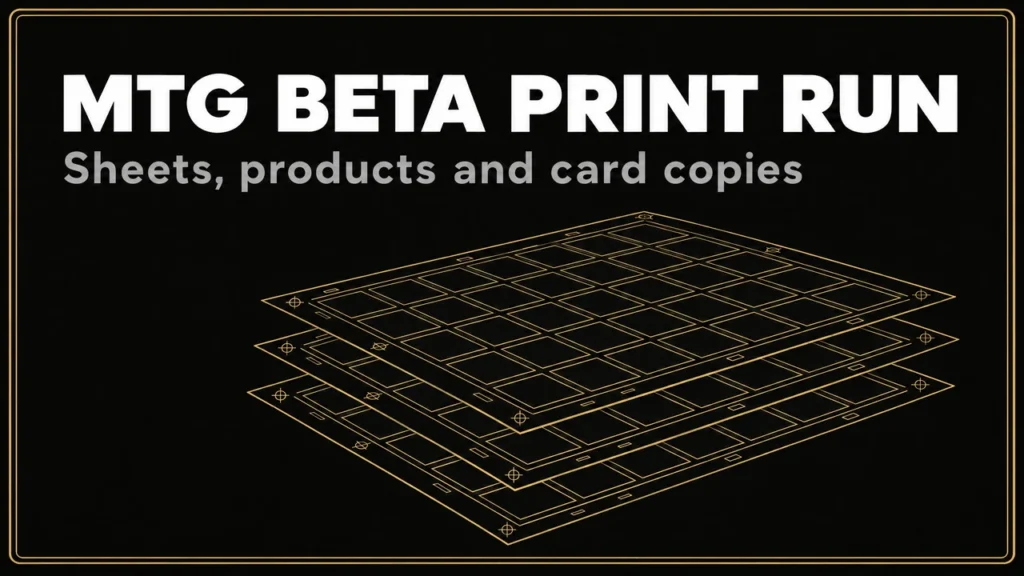
The MTG Beta print run is 7,837,654 cards: 3,024 Rare sheets, 13,602 Uncommon sheets and 48,148 Common sheets, each with 121 positions. Booster packs and starter decks contain 7,837,560 of those cards. The remaining 94 are printed sheet positions outside the products.[1]
That total answers how many Beta cards the printing sheets contain. Individual card counts answer a different question: how often a particular card appears across those sheets. Connecting the two explains why a Beta rare has 3,024 copies while an uncommon or common can have a much larger count.
How the MTG Beta print run connects sheets and products
Beta used three printing streams: Rare, Uncommon and Common. Each sheet held an 11×11 grid of cards. The sheet count records how many times the printer ran that layout; the positions record what each sheet carried. Those two quantities give the total printed cards.[1]
| Beta printing stream | Sheets | Positions per sheet |
|---|---|---|
| Rare | 3,024 | 121 |
| Uncommon | 13,602 | 121 |
| Common | 48,148 | 121 |
The Beta edition page supplies these counts and the product quantities. The full-sheet calculation is (3,024 + 13,602 + 48,148) × 121 = 7,837,654 cards.[1] Rare, Uncommon and Common here identify the printing streams, not three groups that exclude basic lands. Lands occupied positions on the same sheets as other cards.
Packaging gives a second view of that output. Beta used 15-card boosters and 60-card starter decks. The starter’s rulebook accompanied the cards but does not count as a printed Magic card.[1]
| Beta product | Product count | Cards per product |
|---|---|---|
| Booster pack | 209,304 | 15 |
| Starter deck | 78,300 | 60 |
Together, these boosters and starters contain 7,837,560 cards.[1] That is the product total, not the full print run.
The products draw cards from all three streams. Boosters use one Rare, three Uncommon and eleven Common slots; starters use two Rare, thirteen Uncommon and forty-five Common slots. A slot can supply a basic land when a land occupies its sheet position.[1] For the broader history and purpose of these formats, see the 1993 booster and starter guide.
Where the 94 cards outside Beta products fit
Full sheets and complete products need not end at the same card count. After the sheets supply the specified boosters and starters, Beta has 30 positions left from the Uncommon stream and 64 from the Common stream. Together they account for all 94 cards outside the products.[1]
Those positions remain part of the print run because the sheets include them. They do not constitute another booster or starter. The accounting therefore reads 7,837,560 cards in products + 94 outside products = 7,837,654 printed cards.[1]
“Outside the products” describes their place in the production balance, not their later fate. It does not identify which card names occupied the leftover positions or establish that those cards reached players. The distinction lets readers count printed sheets and packaged cards without silently treating them as the same quantity.
Why public references quote a 7.83-million Beta print run
MTGInformation reports a public Beta figure of 7.83 million cards. Its account attributes purchase-order information to Peter Adkison’s March 2021 correspondence with former Carta Mundi sales executive Luc Mertens and an archive check involving Peter de Weerdt. The quantities it lists are 78,000 starter decks and 210,000 boosters.[3]
That figure counts cards through the product quantities in that source. MTGPrintRun’s Beta page instead publishes 78,300 starters and 209,304 boosters, then connects their card contents to whole 121-position sheets. The calculation here includes both those products and the 94 printed positions outside them.[1] [3]
The distinction is not simply whether a writer uses commas or abbreviates a number in millions. The product inputs differ, and the full-sheet total includes positions beyond packaged output. Comparing the sources requires keeping those counting steps visible.
In particular, the 94-card residual explains the difference between MTGPrintRun’s product total and its full print run. It does not, by itself, explain the entire difference from the other source’s 7.83-million figure. Nor should readers attribute MTGPrintRun’s full-sheet total to a Wizards publication: the public comparison above comes through MTGInformation’s account of the correspondence.[1] [3]
Beta release date: October 4 or October 1, 1993?
MTGPrintRun lists Beta’s release date as October 4, 1993. Card Kingdom’s historical article uses the same date, and Scryfall’s Beta set record also lists October 4.[1] [4] [5]
Wizards of the Coast’s current Gatherer record differs: it lists October 1, 1993 for Limited Edition Beta. Both databases identify the same 302-entry set, but they do not agree on the day.[5] [6]
October 4 is the date used by the Beta edition page linked here. The Gatherer entry should remain visible in any discussion of the discrepancy. These records do not establish a reason for the difference, so there is no basis here to label one date a shipping day and the other a retail launch. The shared historical point is the October 1993 second printing, following Alpha’s August release.[2] [4]
Why Wizards printed more Beta after Alpha
The immediate reason was demand. Card Kingdom’s account describes Magic selling out almost immediately after its initial release, prompting Wizards to arrange a second print run. Beta replenished the original game rather than introducing a separate expansion.[4]
The scale increased to roughly three times Alpha. MTGPrintRun publishes an Alpha print run of 2,612,632 cards, compared with Beta’s 7,837,654. The Beta booster and starter counts also follow the threefold increase recorded on the edition pages.[1] [2] The original printing’s history belongs in the Alpha print run article; the relevant point here is how Beta expanded supply through the same product formats.
A larger print run did not turn every card into an equally frequent printing. More passes through the Rare sheets increased rare-card output, while the much larger Uncommon and Common sheet volumes supplied their respective product slots. Beta’s growth increased card availability across the original selection without removing the production differences between rarity streams.
Alpha also has printed cards outside its products: 112, compared with Beta’s 94.[1] [2] These different remainders explain why tripling the product quantities does not require every full-sheet quantity to follow the same multiple. “Three times Alpha” describes Beta’s production scale; it should not erase the separate sheet and product counts.
The two new names and five additional land illustrations
Beta added Volcanic Island and Circle of Protection: Black, which Alpha had omitted. Card Kingdom identifies them as the only two Beta cards that had not appeared in the first printing.[4]
The checklist also expanded the basic lands from two illustrations per land type in Alpha to three in Beta. Across Plains, Island, Swamp, Mountain and Forest, that adds five artwork entries. Alpha’s 295 entries therefore become Beta’s 302 through two additional card names and five additional illustrations.[1] [2]
Those seven additions are not seven new card names. The extra land illustrations share the existing basic land names, and a checklist entry is not the same thing as the number of physical copies printed. These distinctions matter when comparing an edition’s size with its print run.
Beta also has less rounded corners than Alpha.[4] For the complete comparison of card-pool changes, corrected errors and physical identification, use the Alpha vs Beta guide. This article keeps that context brief rather than repeating its identification checklist.
Beta rare copies: Black Lotus as a sheet example
Beta Black Lotus has 3,024 printed copies, as shown on its public card page.[7] It occupies a single position in the Rare layout, so each pass through that sheet contributes one copy. The 3,024 Rare sheets connect the edition-wide calculation to this individual card count.
That is a production figure, not a count of surviving cards or graded examples. It also refers only to Beta, not all Black Lotus editions combined. The Black Lotus page remains the place for the edition-by-edition comparison and current card information.
Beta uncommon and common copies follow sheet frequency
Air Elemental provides the uncommon example: its public page lists 13,602 Beta copies. Lightning Bolt provides the common example, with 48,148 Beta copies.[8] [9] Both appear once in their respective sheet layouts, so their counts follow the number of passes through those sheets.
| Beta card | Printing stream | Copies printed |
|---|---|---|
| Black Lotus | Rare | 3,024 |
| Air Elemental | Uncommon | 13,602 |
| Lightning Bolt | Common | 48,148 |
The difference comes from the volume of sheets carrying each card, not from an extra copy hidden within every product. Follow the Air Elemental and Lightning Bolt pages for their full printing histories.[8] [9]
Do not apply these single-position counts automatically to basic lands. Their repeated positions, presence across printing streams and artwork variants require the relevant land entry. The print sheets and rarity guide explains the general mechanics; Beta’s edition page supplies its card-specific figures.
Using Beta print run data without mixing editions
The Beta archive remains the complete card catalogue. Use this article to connect its production quantities: sheets count printing passes, products count packaged cards, and individual entries count copies of a particular printing. Each figure has a different unit.
Collectors’ Edition and International Edition use a different product structure despite reproducing Beta’s checklist. Their fixed boxed sets do not behave like randomized Beta boosters or starters. The CE/IE boxed-set article covers that distinction without adding those cards to Beta’s print run.
For a Beta booster or starter question involving a wishlist, the Odds Calculator offers the relevant product calculation. A larger total print run and the chance of finding a card in one product are separate quantities. The MTGPrintRun methodology provides the wider framework for keeping sheets, positions and products connected.
References
- MTGPrintRun: Beta print run, sheets and product counts.
- MTGPrintRun: Alpha print run and checklist.
- MTGInformation: Print Run Calculations, including its account of Adkison’s March 2021 correspondence.
- Jacob Lackner, Card Kingdom: This Day in Magic History — Beta, October 4, 2022.
- Scryfall: Limited Edition Beta set record.
- Wizards of the Coast, Gatherer: Limited Edition Beta set record.
- MTGPrintRun: Black Lotus copies by edition.
- MTGPrintRun: Air Elemental copies by edition.
- MTGPrintRun: Lightning Bolt copies by edition.