In August 1993, Wizards of the Coast released a product that would permanently alter tabletop gaming. Magic: The Gathering debuted as the Alpha edition. Today, Alpha cards rank among the most coveted artefacts in the trading card hobby. Pristine copies of the Black Lotus command hundreds of thousands of dollars at auction. But behind the astronomical prices lies a fascinating industrial story of constraints, factory logistics, and a production run that nobody intended as a limited edition.
Understanding Alpha’s exact scarcity requires looking past the mythology. The real story lives in the Carta Mundi printing presses in Turnhout, Belgium. Here is the true account of the first Magic: The Gathering print run.
The Genesis: Wizards of the Coast and the Carta Mundi Contract
In early 1993, Wizards of the Coast operated as a small role-playing game publisher out of Peter Adkison’s basement. When Richard Garfield pitched a portable, quick-playing card game, Adkison recognised its potential immediately. The challenge: manufacturing it. Printing randomised, collated trading cards with high-quality art demanded a complex industrial process. Domestic printers either charged too much or lacked the specialised collation technology.
The solution came from Belgium. Carta Mundi, a long-established manufacturer of playing cards and casino equipment, offered exactly the capabilities Wizards needed. They could print high-resolution artwork on premium card stock. Crucially, they owned the automated machinery to randomise and package cards into booster packs and starter decks.
The initial order represented a massive financial risk for the young company. The factory required a minimum volume to justify setup costs. Wizards had to secure advance orders from distributors to fund the print run. The final contract for the first printing — what we now call Alpha — covered roughly 2.6 million cards.
The Mathematics of the Press: 11×11 Sheets
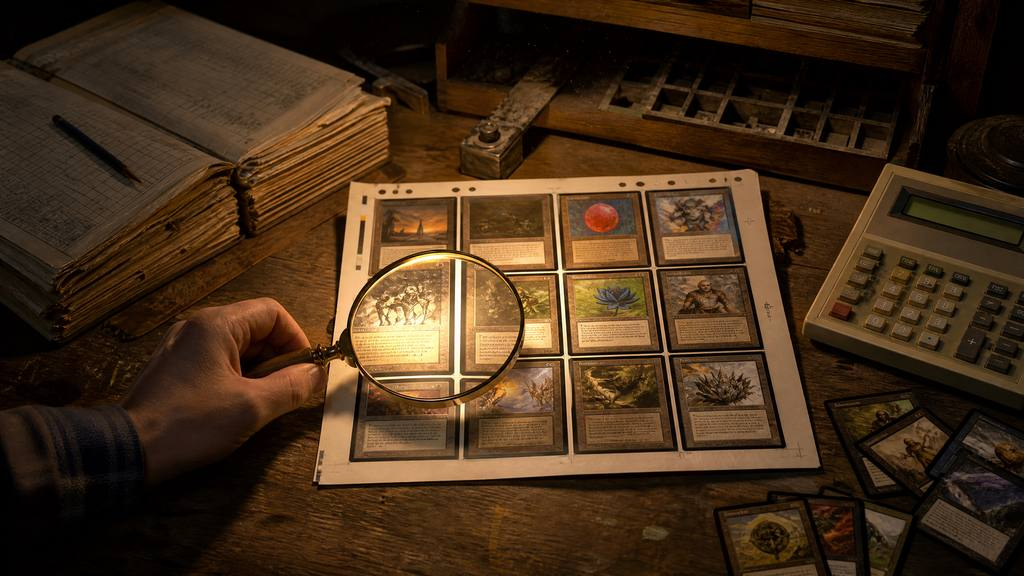
The industrial reality of Carta Mundi’s presses dictated the scarcity of every card in the set. The factory printed cards on large sheets, each containing exactly 121 card positions in an 11×11 grid. This physical constraint forms the foundational equation for all MTG print run calculations.
The Alpha set contained 295 distinct cards, divided into three rarity tiers: Rare, Uncommon, and Common. Carta Mundi created three separate print sheets to accommodate them:
- Rare Sheet: 121 slots
- Uncommon Sheet: 121 slots
- Common Sheet: 121 slots
However, the set included Basic Lands and the factory did not use a dedicated land sheet. The printers distributed these lands across the three main sheets to balance the numbers. This phenomenon, known as “land invasion,” meant that an Island could occupy a slot on the rare sheet instead of a rare spell. This logistical quirk explains why calculating exact pull rates requires more than simple division — a challenge our database solves by reconstructing the exact sheet layouts.
The Final Count: How Many Alpha Cards Were Printed?
For nearly three decades, community guesswork dominated the discussion around Alpha’s exact production numbers. Then in March 2021, Peter Adkison referenced original Carta Mundi factory records and confirmed the exact figures [1].
The total Alpha print run reached exactly 2,609,728 cards. The factory packaged this total into two products:
- 69,768 Booster Packs (15 cards each)
- 26,100 Starter Decks (60 cards each)
Every card sits on a 121-card sheet, so the total production of any rarity tier must be a perfect multiple of 121. When we apply the packaging equations (a booster contains 1 rare, a starter contains 2 rares), the math aligns perfectly with the factory records.
The Carta Mundi presses produced exactly 1,008 copies of each rare card on the rare sheet. For every iconic Alpha rare — from Black Lotus to the Moxen, from Time Walk to Ancestral Recall — only 1,008 copies ever left the factory floor.
| Rarity Tier | Total Copies Printed (Per Card) |
| Rare | 1,008 |
| Uncommon | 4,530 |
| Common | 16,030 |
Note: These figures represent the documented factory production run. The number of surviving copies today, especially in high grade, is significantly lower due to three decades of attrition, play, and loss.
The Two-Week Sellout and the Rush from Alpha to Beta
When Alpha debuted at the Origins Game Fair in August 1993, the reception exceeded all expectations. The initial print run of 2.6 million cards, which Wizards had hoped would last for months, sold out almost instantly. Distributors were clamouring for more product, and the secondary market began to form before the ink was fully dry.
The immediate sellout created a crisis. Wizards of the Coast had to rush back to Carta Mundi to order a second printing, which would become the Beta edition. To fix several layout errors and omissions in Alpha (such as the missing Volcanic Island and Circle of Protection: Black), the Beta print run was expanded to 302 cards. Beta was printed in much larger quantities—nearly triple the volume of Alpha, at over 7.8 million cards. Still, even that proved insufficient to meet the exploding demand, leading to the massive 35-million-card Unlimited run by December.
The Legacy of the First Print Run
Today, Alpha stands as a monument to the birth of the trading card game industry. Its distinctive heavily rounded corners, black borders, and raw, unfiltered artwork represent the game in its purest form.
For data researchers and collectors, Alpha is the perfect baseline. Because its numbers are confirmed by primary sources and its sheet mathematics close with a zero remainder, it serves as the anchor for reconstructing the logistics of all subsequent editions. We use advanced computational models—and increasingly, AI-assisted data reconciliation tools—to map these early factory constraints and derive the exact scarcity of every card.
The 1,008 copies of an Alpha rare are not just a collector’s metric; they are a historical artifact of a time when a small company in a basement changed gaming forever.
References:
[1]: Elite Fourum. We now have official MTG print run numbers! (March 2021). Discussion of Peter Adkison’s confirmed Carta Mundi figures.