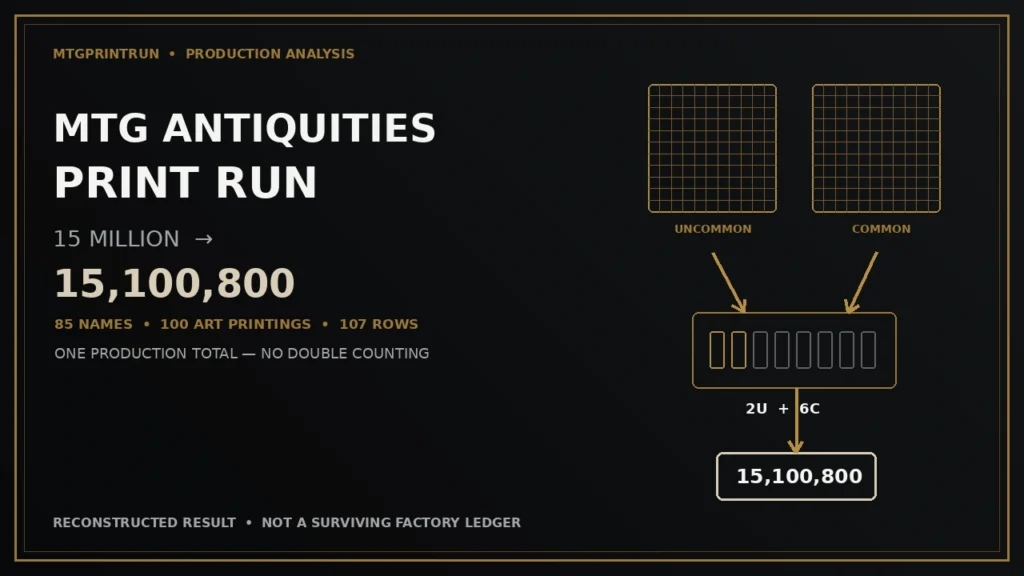
Historical sources usually summarize the MTG Antiquities print run as approximately 15 million cards. MTGPrintRun’s adopted industrial reconstruction reaches 15,100,800 cards. The 100,800-card difference equals 0.672%, which remains fully compatible with a public figure rounded to 15 million.[1] [2]
Quick answer: Antiquities used two 121-position sheets and eight-card boosters containing two cards from the uncommon sheet and six from the common sheet. The validated model requires 31,200 uncommon sheets, 93,600 common sheets and 1,887,600 boosters. Together, they produce 15,100,800 cards. This reconstructed result does not represent a surviving Carta Mundi factory ledger.[2] [3]
Why the Antiquities 15 Million Figure Is Historically Sound
A Wizards-era expansion timeline described Antiquities as an 85-card set released in March 1994 and reported 15 million cards printed. The current set record specifies the release date as March 4, 1994, while Crystal Keep preserves the same 15-million figure as a Wizards-announced print run.[1] [4] [5]
That historical statement communicates the correct scale, but it cannot prove that the production line delivered exactly 15,000,000 physical cards. Any precise industrial reconstruction must also reconcile whole sheets with complete boosters.
MTGPrintRun’s result exceeds the public figure by only 0.672%:
| Measure | Cards | Difference from 15 million |
|---|---|---|
| Public historical figure | 15,000,000 | — |
| MTGPrintRun reconstructed total | 15,100,800 | +100,800 |
Both figures therefore describe the same production scale. The public number remains a valid rounded statement, whereas the reconstructed total supplies the precision required by the adopted production constraints.[2]
Antiquities Counts: 85 Names, 100 Art Printings and 107 Rows
These three totals are all correct, but each one measures a different layer of the edition.[2] [3] [5]
Base Checklist: 85 Card Names
The edition contains 85 base card names. This count defines the archive at set level and identifies the base rows that must enter the edition-total calculation.[1] [2]
Artwork Count: 100 Distinct Printings
Five nonbasic lands have four artworks each: Mishra’s Factory, Strip Mine, Urza’s Mine, Urza’s Power Plant and Urza’s Tower.[3]
With one artwork per name, the 85-card checklist would yield 85 physical art identities. Replacing five single identities with twenty artwork identities adds fifteen physical printings:
85 base names − 5 multi-art names + 20 artwork printings = 100 distinct art printings
Those fifteen additional printings do not introduce new card names. Instead, they create artwork-level records beneath five existing names.[2] [3]
Dataset Structure: 107 Logical Rows
MTGPrintRun organizes the master dataset into 107 logical rows:
- 85 base rows, one for each card name;
- 20 artwork-level child rows, four for each of the five multi-art lands;
- 2 unresolved child rows for the normal and offset forms of Tawnos’s Weaponry.[2]
The Tawnos’s Weaponry child rows record two known physical forms without assigning an unsupported numerical split between them.[2] [3]
Because these layers describe a data model, they cannot be added together as production quantities. Keeping that distinction prevents double counting.
Antiquities Print Sheets: Two 121-Position Layouts
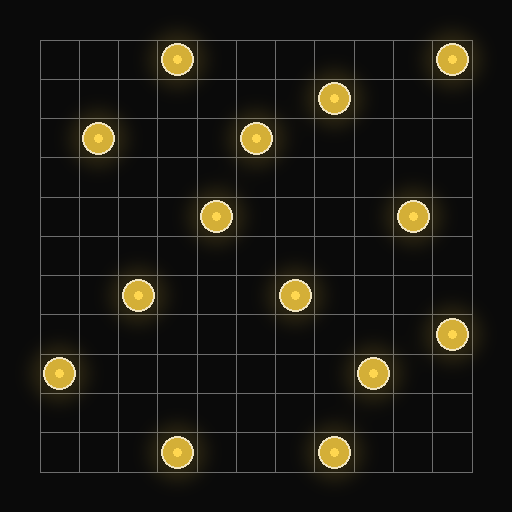
Production used two 11×11 sheets: one uncommon sheet and one common sheet. Each layout contained exactly 121 positions. Every booster then drew two cards from the uncommon stream and six from the common stream.[3] [4]
The verified sheet composition closes as follows:
| Sheet | Frequency groups | Slot check |
|---|---|---|
| Uncommon | 26 U1, 4 U2, 29 U3 | 26×1 + 4×2 + 29×3 = 121 |
| Common | 11 C1, 5 C2, 25 C4 | 11×1 + 5×2 + 25×4 = 121 |
These labels indicate sheet frequency, not modern rarity. U1 identifies a printing that occupies one position on the uncommon sheet; C4 identifies one that occupies four positions on the common sheet. Antiquities has no separate rare sheet. Collectors generally treat the least frequent uncommon-sheet printings as the set’s rares.[3]
Artwork-level positions also contribute to the common-sheet total. For example, individual artworks of an Urza land can carry different frequencies even though the archive retains one base card name. The base row aggregates those artwork positions, while its child rows document their distribution.[2] [3]
How the Antiquities Reconstruction Reaches 15,100,800 Cards
The adopted model requires 31,200 uncommon sheets and 93,600 common sheets. Multiplying each run by 121 positions gives two production streams:[2]
Uncommon stream: 31,200 × 121 = 3,775,200 cards
Common stream: 93,600 × 121 = 11,325,600 cards
Combining those streams produces the edition total:
3,775,200 + 11,325,600 = 15,100,800 cards
Product-level arithmetic independently reaches the same result. Each Antiquities booster contains eight cards:[2] [3]
1,887,600 boosters × 8 cards = 15,100,800 cards
The individual slot streams also reconcile:
- 1,887,600 boosters × 2 uncommon-sheet cards = 3,775,200 uncommon-stream cards;
- 1,887,600 boosters × 6 common-sheet cards = 11,325,600 common-stream cards.
Each result matches its corresponding sheet total exactly. The model leaves no fractional sheets and no cards outside the booster calculation.[2]
Compatibility with the rounded 15-million statement alone does not justify selecting 15,100,800. The adopted figure earns its role by closing simultaneously across both sheet streams and booster collation.
How Antiquities Rarity Codes U1–U3 and C1–C4 Work
Every frequency code combines two elements:
- the letter identifies the source sheet: U for uncommon or C for common;
- the number states how many positions that printing occupies on the sheet.
Final copy quantity depends on both the frequency and the number of sheet impressions. Under the adopted model, a U1 printing appears once on each of 31,200 uncommon sheets, while a C1 printing appears once on each of 93,600 common sheets.[2]
For this reason, the codes do not behave like modern rarity symbols. Although C1 carries a lower frequency number than U3, production ran the common sheet three times as often to support the booster’s six-to-two slot ratio. Consequently, U3 and C1 printings reach the same artwork-level quantity in the model.[2]
The Arabian Nights rarity guide explains the general logic behind early expansion frequency codes. Antiquities follows the same notation convention, but its sheet contents, card identities and artwork structure require a separate calculation.
The Antiquities Anti-Double-Counting Rule
Only the 85 base rows enter the edition-total sum. Artwork rows and unresolved variant rows function as descriptive children of those base records.[2]
| Layer | Purpose | Add to edition total? |
|---|---|---|
| 85 base rows | One aggregate record per card name | Yes |
| 20 artwork child rows | Break down five multi-art land names | No — already included in their base rows |
| 2 Tawnos’s Weaponry child rows | Record normal/offset forms with unresolved split | No — already included in the base U3 total |
| 100 distinct art printings | Collector-facing count of physical artwork identities | No — not an additional production layer |
| 107 logical rows | Database structure | No — rows are not additive production units |
Mishra’s Factory demonstrates the rule clearly. Its base card aggregates four artworks: one belongs to the common sheet and three belong to the uncommon sheet. The base total already combines all four physical contributions, so adding the child rows again would count the same Factory cards twice.[3] [6]
Strip Mine and the three Urza lands follow the same structure. Base rows answer, “How many copies of this card name does the model contain?” Artwork rows answer, “How does that base total divide among physical art printings?” Both views describe the same production rather than independent quantities.
Tawnos’s Weaponry introduces a second constraint. Its U3 base record has a quantified model total, and surviving evidence confirms normal and offset forms. However, that evidence does not establish how the total divides between the two variants.[2] [3] [7]
Correct treatment therefore requires four actions:
- retain the base quantity;
- record both physical variants;
- leave the variant split unavailable;
- reject an assumed 50/50 division and never add unknown variant quantities above the counted base total.
What the Antiquities Model Establishes—and What It Cannot
The reconstruction links seven validated elements:
- the historical scale of approximately 15 million cards;
- two complete 121-position sheets;
- the 2U/6C anatomy of an eight-card booster;
- 31,200 uncommon-sheet impressions;
- 93,600 common-sheet impressions;
- 1,887,600 boosters;
- the 15,100,800-card edition total.[1] [2] [3]
Those relationships do not transform the result into a surviving factory ledger, reveal the current population or quantify the normal/offset split of Tawnos’s Weaponry. Nor do they justify adding base cards, artworks and database rows together.[2]
The Antiquities Edition database applies the model card by card. For comparison, the Mishra’s Workshop page presents one U1 printing, while the Mishra’s Factory page aggregates a multi-art card name whose printings span both sheets.
Antiquities Print Run: The Bottom Line
The public estimate of about 15 million cards and MTGPrintRun’s reconstructed total of 15,100,800 describe the same historical production at different levels of precision. Two 121-position sheets and eight-card boosters reconcile simultaneously with the uncommon and common streams, which closes the reconstructed figure.[1] [2] [3]
A second conclusion concerns structure: 85 names, 100 art printings and 107 logical rows do not represent competing set sizes. Each count describes a separate view of Antiquities. Summing only the base-name layer—and treating artworks and unresolved variants as child detail—preserves the 15,100,800-card total without double counting.
For broader manufacturing context, consult MTG print sheets and rarity explained and the project’s print run methodology.[8]
Sources and References
- The Duelist: A Special Preview Edition — “An Expansion Timeline”
- MTGPrintRun — Antiquities Edition production archive
- The Collation Project — Antiquities
- Crystal Keep mirror — Antiquities product information
- Scryfall — Antiquities set record
- MTGPrintRun — Mishra’s Factory card page
- MTGPrintRun — Tawnos’s Weaponry card page
- MTGPrintRun — Our Methodology